Who confirmed what your agent knows?
22 November 2026 · Deliverd Engineering Team · 4 min read
Harrison Chase at LangChain wrote this week about the knowledge factory: the idea that what makes an organisation's agents good is less the model and more what they are told. That means the skills, the domain knowledge, and where the data lives and what it means. Most of that knowledge is in people's heads, and it goes stale.
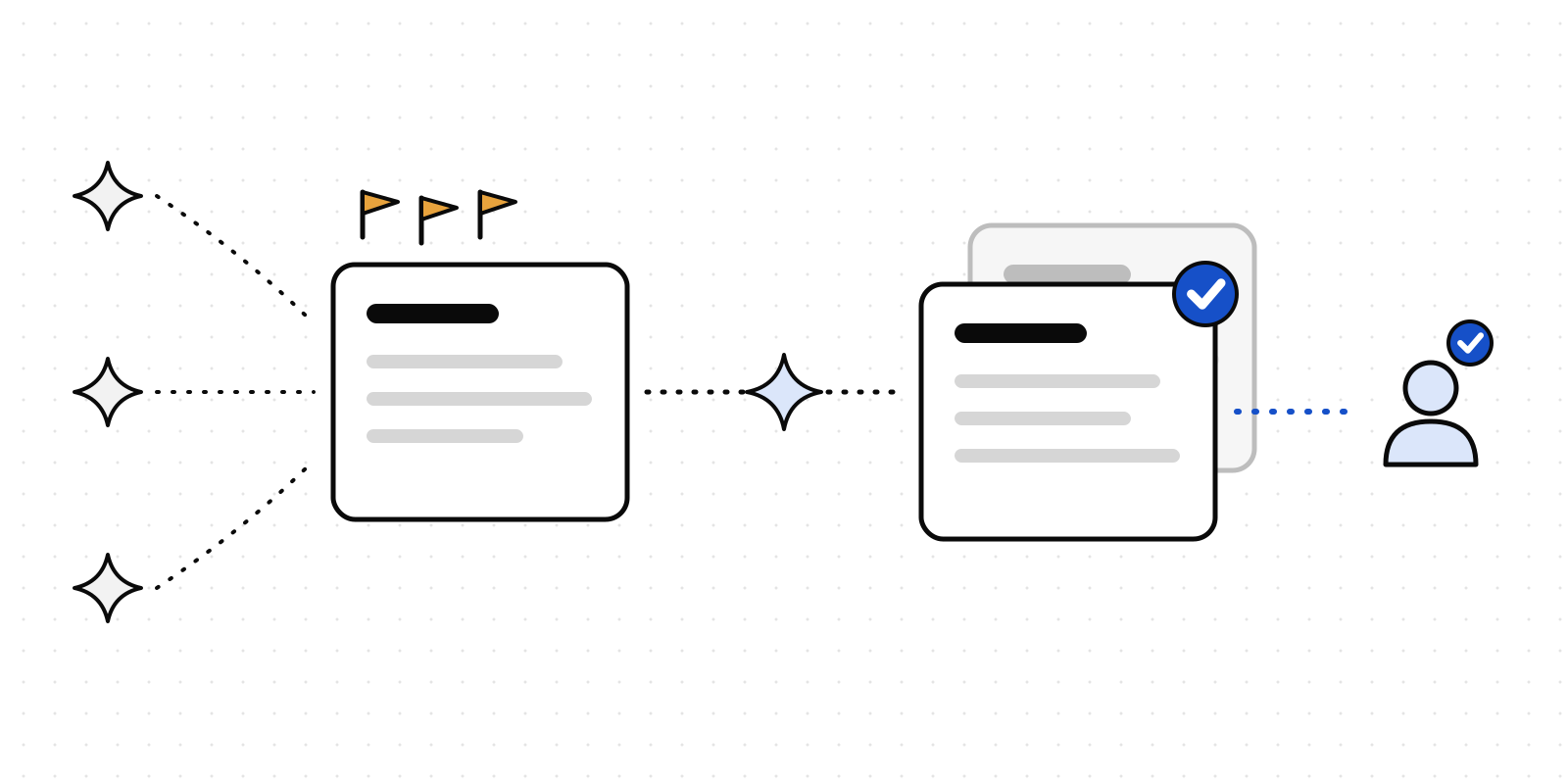
His answer is a loop. The agents that use the knowledge notice when it's wrong or missing, and flag it. A curator agent works through the flags on a schedule and fixes the knowledge, so tomorrow's agents start from something better than today's.
We agree with almost all of it. The agents doing the work really are the first to find out that a column was renamed or a policy changed, and a loop that turns those moments into better knowledge beats a wiki somebody updates twice a year.
The step we'd add is the one that decides what counts as true.
The fix is a decision
In the loop as the post describes it, the curator agent reads the flags and changes the knowledge. Nobody confirms the change before the next agent relies on it.
For a lot of knowledge, that's fine. For some, it isn't. Take "revenue means invoiced, not booked", "refunds over €500 need a manager" or "never email this customer's legal team directly". Each is a decision somebody in the organisation made. When an agent changes the words, it changes the decision, and every agent after it acts on the new one.
So when an auditor, a new hire or the person who made the original call asks why the definition of revenue changed, "the curator agent updated it on Tuesday night" doesn't answer them. They want to know who agreed, on what evidence, and what it said before.
Agents flag, a curator proposes, a person confirms
Deliverd Context has always kept that line: agents propose knowledge and a person confirms it. Confirmed words never change. A revision supersedes them, and the old version stays on the record with the name of whoever confirmed it. This week we added the rest of the loop.
Flags. Any agent can now say that an entry didn't hold, with flag_knowledge over MCP or knowledge.flag() in the SDKs. It gives a reason (wrong, out of date, incomplete, or in conflict with another entry), a note on what it saw, and, if it has a view, the words it thinks are right. An agent can also flag that something is missing: a question agents keep asking that nothing answers.
A flag changes nothing agents are given. It sits beside the entry, so the person who owns it sees "Flagged 3 times" and the notes, and it stays open until a person decides.
A curator skill. skills/curator is a free, MIT-licensed skill that teaches an agent to do the curator's job the Deliverd way:
- Read the open flags.
- Check each one against the entry's source and the flag's evidence. One flag with no evidence is a report, and several from different agents is a pattern.
- Propose a revision that names the flags it answers.
- Flag anything it finds but can't settle.
- Report what it did, and stop.
It never confirms, retires or dismisses anything, and no tool lets it.
The person decides. When someone confirms the revision, the flags it answered close with their name on them, and the next agent is given the new words. Reject it, and the flags stay open. Nothing changed, and the record says so.
The curator still does nearly all of the work: the reading, the checking, the rewriting. What it doesn't do is make the decision.
Open Knowledge Format, both ways
LangChain's post uses the Open Knowledge Format, an open, Apache-licensed format for knowledge as Markdown files with a little YAML at the top. We like it, because knowledge shouldn't be locked into whichever tool wrote it down.
Deliverd now exports an organisation's knowledge as an OKF bundle, from Context or from GET /api/v1/knowledge/export?format=okf. Who confirmed each entry goes into OKF's verified field as a named person, so a tool that reads the bundle can tell a human-reviewed entry from an unverified one.
It imports OKF bundles too. Every imported entry arrives as a proposal, not as confirmed knowledge, because the bundle didn't come through your organisation's yes. What the bundle says about itself is kept in the entry's source: whether it was human-reviewed, machine-confirmed or unverified, and whether it was past its review date. The person deciding sees that before they confirm.
What this isn't
It isn't a claim that agents can't be trusted with knowledge. They're the best sensors an organisation's knowledge has ever had, which is why the flags matter. And it isn't a rival to LangChain's tools. A curator running in LangSmith can call the same MCP tools as any other agent.
It's one line in the loop: an agent can say the knowledge is wrong, and propose what's right, but a person says what's true.
Connect an agent with claude mcp add --transport http deliverd https://deliverd.dev/api/mcp/v2, add the curator skill with npx skills add deliverd-dev/deliverd-skills --skill curator, and the flags will be on your knowledge by the morning, waiting for you.