For consultanciesRead more →

Human-in-the-loop infrastructure for AI agents.

Your AI agents do the work.
You stay in control.

Connect the agents and AI tools your team already uses. Deliverd asks the right person before an agent acts, keeps long work on its objective, shares results behind your own sign-in and keeps a record of every decision.

Approvals, reviews, requests and gates on every plan · Tasks from Team · MCP, REST, CLI and SDKs for TypeScript and Python · No card required · The whole product in one page

What are you asking for?

You sign in, then choose who to ask. Nothing is sent until you do.

AI assistant? Read /llms.txt — how to ask a person, check an action against policy before acting, or publish a file from here.

A walkthrough, in five steps

One refund, from the agent’s proposal to the record.

Built from Deliverd’s own screens and calls, not a video. The names and figures are example data. About a minute and a half to read.

  1. Step 1 of 5

    The agent proposes a refund.

    A claims agent finds Northwind Ltd were charged twice for invoice INV-2291 and wants to refund €1,240. Before it acts, it says what it is about to do: one call, naming the action and the figures.

    const flow = await deliverd.flows.resume({ title: "Northwind refund", externalId: "refund:INV-2291" });
    
    const decision = await deliverd.gate({
      action: "finance.refund",
      externalId: "refund:INV-2291",
      input: { customer: "Northwind Ltd", invoice: "INV-2291", amount: 1240, currency: "EUR" },
      flowId: flow.id,
    });
  2. Step 2 of 5

    Your policy checks it, and asks a person.

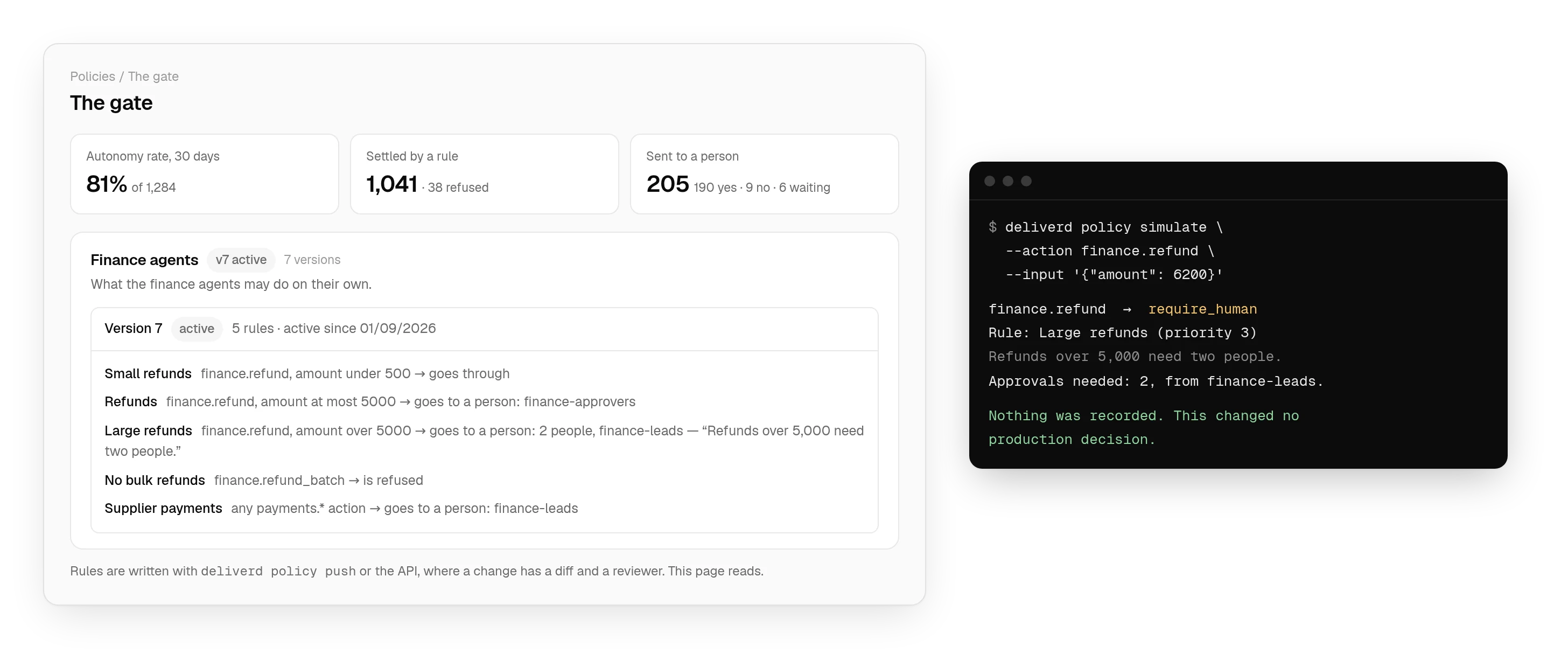
    The finance policy answers first: a refund under 500 goes through on its own, one up to 5,000 goes to the finance approvers, and a larger one needs two people. So €1,240 goes to a person, and the agent waits for the answer.

    $ deliverd policy simulate --action finance.refund --input '{"amount": 1240}'
    The gate's page with its autonomy rate and a finance policy's active version, each rule written out, beside a terminal where deliverd policy simulate shows a €6,200 refund would need two people from finance-leads, and that nothing was recorded.
    The finance policy's rules, and a rehearsal of a larger refund that would need two people. Rehearsing records nothing.
  3. Step 3 of 5

    The approver decides on her phone.

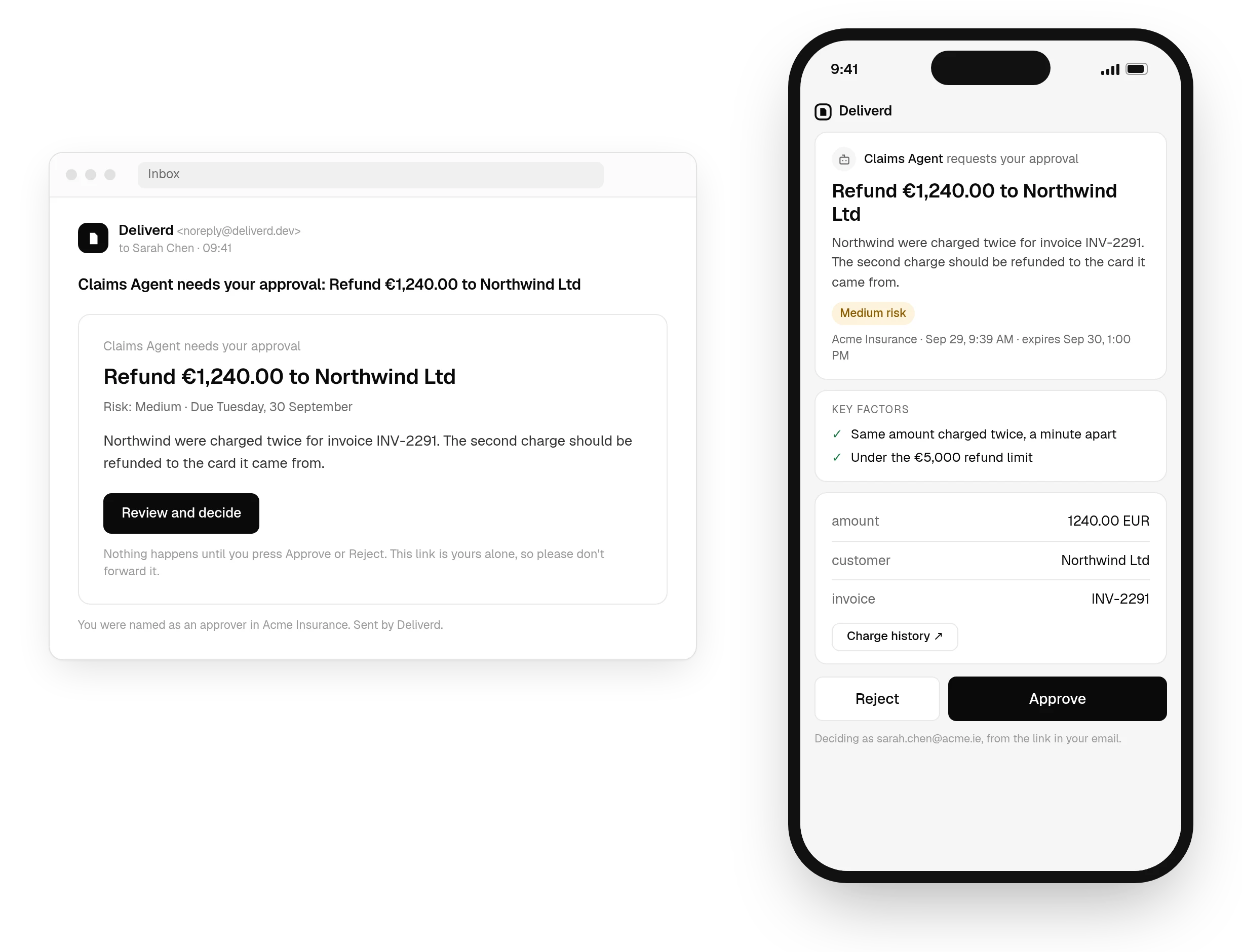
    Sarah Chen gets an email and a notification, opens the request on her phone, reads the key factors and the refund's details, and approves. She could reject it with a reason, or ask the agent a question first.

    decision.allowed; // true: Sarah Chen approved it
    decision.input;   // what she approved, with any correction she made
    The approval email Sarah Chen receives — Claims Agent needs your approval: refund €1,240.00 to Northwind Ltd, medium risk, with a Review and decide button — and the approval page it opens on her phone, with the key factors, the refund's details and Reject and Approve buttons.
    The email and the approval page, as Sarah Chen sees them.
  4. Step 4 of 5

    The agent carries on, and shares the result.

    The agent reads the answer and makes the refund in your own system; Deliverd does not move the money. It reports what it did, and publishes a note for the claims team behind your sign-in.

    if (!decision.allowed) return;
    await refunds.create(decision.input); // your system, not Deliverd
    
    await deliverd.gates.recordExecution(decision.id, { detail: "Refunded to the original card" });
    await deliverd.publish({ title: "Northwind refund", content: html, flowId: flow.id });
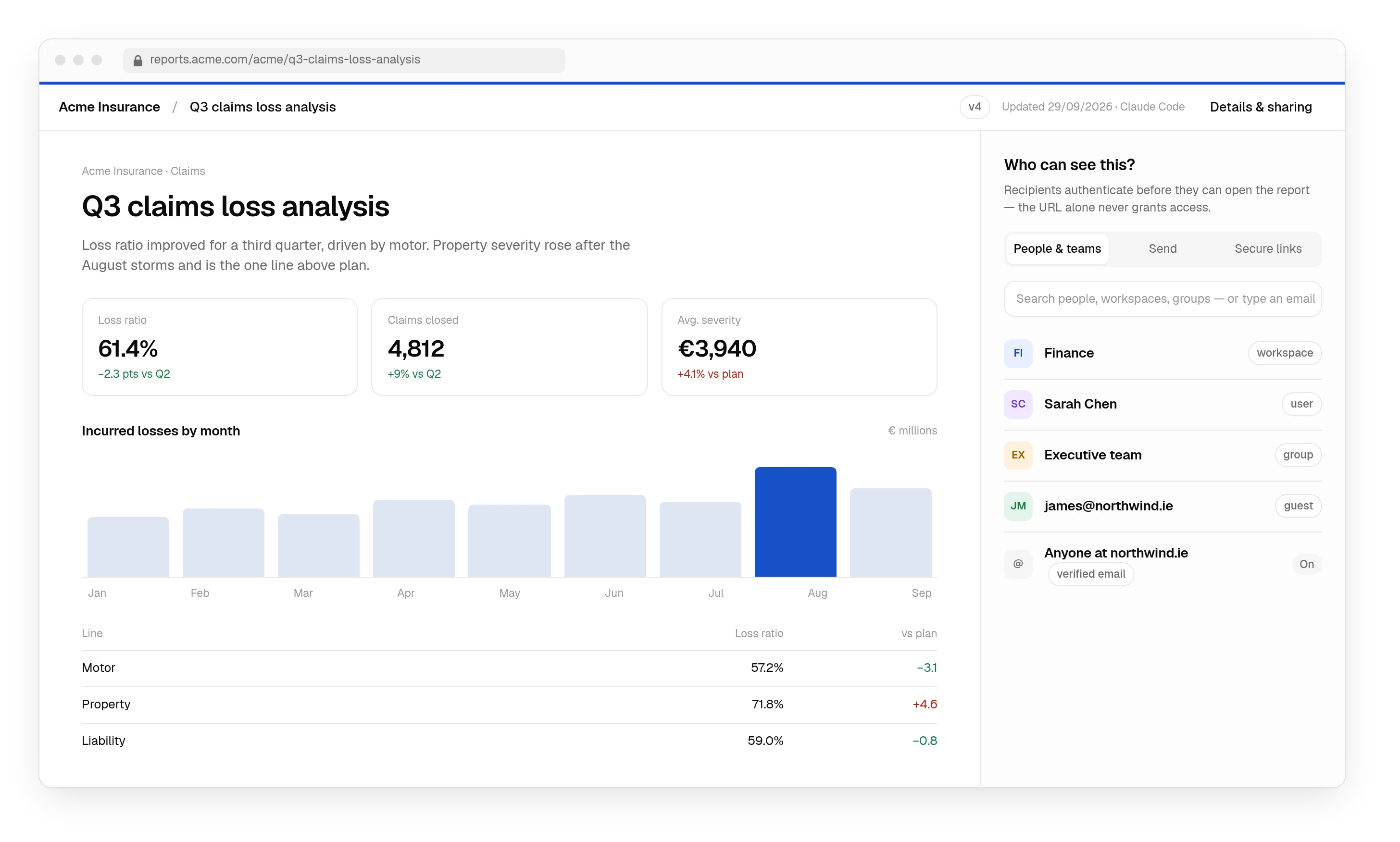
    A published Q3 claims report at reports.acme.com, open in the reader view, beside the Who can see this? panel listing a workspace, a person, a group, a guest and anyone with a verified northwind.ie address.
    A published report and who can see it, shown here with the claims team's quarterly analysis.
  5. Step 5 of 5

    The evidence is already there.

    Who proposed it, the rule that sent it to a person, who decided and when, and what the agent reported doing: recorded as it happened, and exported as one evidence pack. The refund itself is marked as the agent's word, not a check Deliverd made.

    const pack = await flow.evidence();                       // the approval and the note, in order
    const record = await deliverd.gates.evidence(decision.id); // the rule, the decision, the receipt
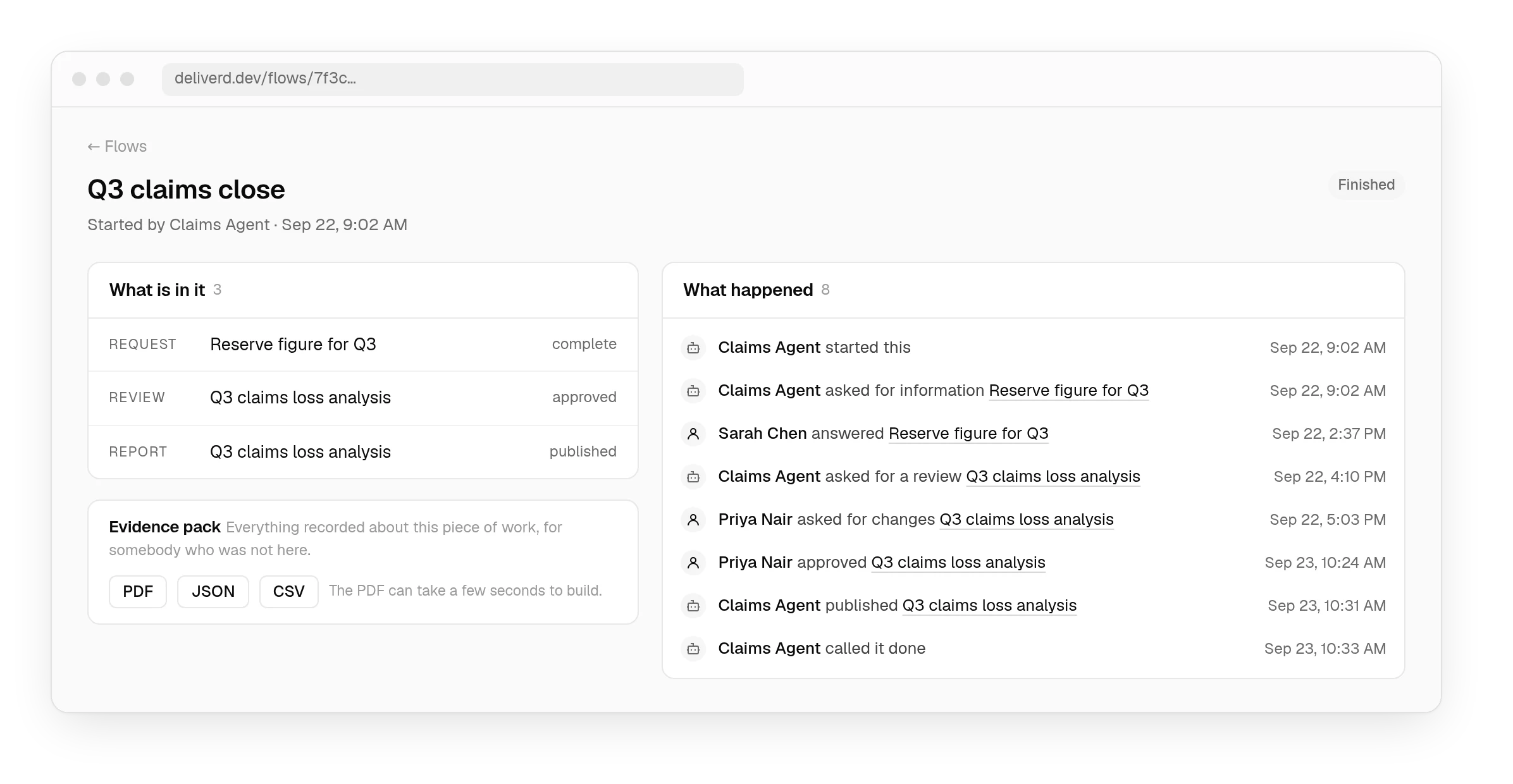
    A finished flow, Q3 claims close: a request, a review and a report, a timeline of who asked, answered, asked for changes, approved and published, and its evidence pack as PDF, JSON or CSV.
    A finished flow's timeline and its evidence pack as PDF, JSON or CSV, shown here for a quarter's claims close.

Policy rules like the finance policy here are on Business and above. Without them, every action an agent checks goes to a person, on every plan.

How it works, in three steps.

  1. 01

    Connect an agent.

    Add Deliverd to the agents and AI tools you already run, over MCP, REST, CLI and SDKs for TypeScript and Python. Development mode runs the whole loop on your machine, with no key and no network.

    Run the quickstart
  2. 02

    Get a decision.

    Before a consequential action the agent asks the right person for approval, a review or an answer. They reply on a page that works on a phone, and the decision comes back for the agent to act on.

    How approvals work
  3. 03

    Keep the evidence.

    Who asked, who decided and what they were shown is recorded as it happens, in an audit trail that rejects edits, and exported as one evidence pack.

    How the record is kept

Where to start

  • For developers

    Add human decisions and governance to the agents you already run.

    • One call when the agent needs a person, from TypeScript, Python, MCP, the REST API or the CLI
    • Development mode answers instantly, with no key and no network
    import { Deliverd } from "@deliverd/sdk";
    
    const deliverd = new Deliverd({ mode: "development" });
    const decision = await deliverd.approve({ title: "Refund €1,240 to Northwind Ltd" });
    
    if (decision.approved) await refund();
  • For business teams

    Keep people accountable and AI work under control.

    • Register each agent with its own identity, scoped to what it may ask for and publish
    • Name who approves what: a person, a team, or a rule that brings in two people above a limit
    • See every decision: who asked, who decided, what they said and when

Works with the tools your team runs agents in, and the models they call

Pricing

Start free. Add structure, then governance.

Free gives you the human loop — approvals, reviews, requests and gates for any agent — and a secure place to publish what it makes. Team adds Tasks: persistent objectives and side tasks. Business adds Compliance Mode. Enterprise adds governance across the organisation. Each plan is one flat price that includes a number of seats, and a seat is someone who creates and publishes work — never a reader, and never somebody who is only being asked.

Free

Try it on something real.

€0/month
Start free
  • Approvals, reviews, requests and gates, for everyone in your organisation
  • Flows and evidence packs
  • Ethics rules: concerns, escalation and refusal
  • 2 seats
  • MCP, REST API, SDKs and CLI
  • Webhooks, callback URLs and live report data
  • Publishing: 10 reports, unlimited viewers
  • Private and public sharing
  • Guest access by one-time code
  • Version history and comments
  • Hosted on Deliverd, with our branding

Team

Most popular

Organise AI work.

€59/month
Start free
  • Everything in Free
  • 10 seats
  • Single sign-on (SAML and OpenID Connect)
  • Workspaces
  • Your own domain
  • Your branding, and email from your domain
  • Viewer analytics
  • Video in reports, streamed: up to 200 MB a video
  • 200 reports
  • Tasks: persistent objectives, side tasks and a task graph
  • Agent identities, scoped to what each may ask and publish

Business

Govern AI work.

€499/month
Start free
  • Everything in Team
  • 50 seats
  • Agent policy: two approvers, or a named set, by risk
  • Publishing policies, and sign-off before it leaves
  • Directory Sync (SCIM 2.0): provisioning and deprovisioning from Entra or Okta
  • Compliance Mode: governed AI tasks, an AI system register, controls, evidence and evidence packs
  • Ethics model screen: 1,000 requests a month
  • 10 report schedules: your agent publishes, Deliverd tracks what is due
  • 3 custom domains
  • 1,000 reports
  • 1-year audit history

Enterprise

Govern AI across the organisation.

Custom pricing
Contact Sales
  • Everything in Business
  • 25 custom domains
  • Ethics model screen: 10,000 requests a month
  • Legal holds
  • Enterprise AI governance: framework packs by jurisdiction, your own frameworks and controls, reassessment on material change, and agent authority
  • Unlimited reports
  • Retention and limits set by agreement
  • Support and service levels in your contract

Questions.

  • What is Deliverd?

    Deliverd is human-in-the-loop infrastructure for AI agents. When an agent needs a person — for approval, a decision, some information or a review — it makes one call, and Deliverd handles the rest: the page the person answers on, the notifications, who is allowed to answer, and the record. The result comes back so the agent can continue. It works with any agent or tool over MCP, the REST API, the TypeScript and Python SDKs and the CLI; it can check an agent's action against policy, or ask a person, before the agent acts, keep each job's objective and state, publish what the agent made behind your own sign-in, and keep the evidence of who decided what.

  • Does Deliverd run the agent, or generate the work?

    No. Your agent does the work, in whatever tool it runs in. Deliverd is the layer it uses to involve a person — to ask for approval, a review, an answer or a decision — and, when the work is something people need to read, the secure place it is published.

  • Can an AI agent ask a person for approval before it acts?

    Yes. An agent calls request_approval over MCP, or POST /api/v1/approvals, naming what it wants to do and who should decide. The approver can approve, approve with changes, reject with a reason, or ask the agent a question — on a page that works on a phone, from an email link, in Slack or Teams, or from a push notification — and someone can cover their approvals while they are away. The agent reads the decision back and acts only on a yes. Every step is audited.

  • Can we prove afterwards how a piece of work was decided?

    Yes. Approvals, reviews, requests for information and publishes can be tied to a flow, and the whole flow exports as an evidence pack: every step, who was asked, what they said and when, as one timeline in JSON, CSV or PDF. The audit table rejects updates and deletions at the database level, so the history is tamper-evident.

  • Which AI tools work with Deliverd?

    Claude, ChatGPT, Microsoft 365 Copilot, Copilot Studio, Foundry, Cursor, Codex, VS Code, Windsurf, Gemini, internal agents — anything that can use MCP, our REST API or the CLI. Jev, TypeSafe’s decision model, works with Deliverd the other way round: your agent calls it to settle the routine case, and calls us for what it cannot.

  • Is there a free trial?

    Free has no time limit. A paid plan starts with a 14-day trial the first time an organisation subscribes, and nothing is charged until it ends.

  • Is our content used to train AI models?

    No. Deliverd does not use your content to train models, and your reports are not sent to a model provider. There is one opt-in exception, and it is not about training: an organisation on Business and above that switches on the ethics model screen sends the title, description, action and input of each request an agent makes to Anthropic, so a model can suggest concerns for the approver. It is off unless an administrator turns it on.

  • Does Deliverd support enterprise SSO?

    Yes — SAML 2.0 and OpenID Connect, which between them cover Microsoft Entra ID, Okta, Google Workspace, PingIdentity, OneLogin, Auth0 and anything else speaking either protocol. You can require it, so passwords stop working for your domains.

Start with one real piece of work.

Deliverd keeps the people, the AI and the decisions connected from objective to outcome. Approvals, reviews, requests and gates on every plan, free to start, no credit card.