Deliverd compared with Claude artifacts
Claude artifacts are excellent.
Until the reader is a client.
Claude Code publishes a session's work to a live page in seconds, and for showing a teammate what an agent just built there is nothing quicker. The boundary appears when the person who needs to read it is a client, an auditor or a board member who does not sign in to your Claude organisation.
Private by default · Unlimited viewers · No card required
Publishing is one of Deliverd’s primitives; the comparison below is about that one. For the rest — an agent asking a person for approval, a review or an answer, and the gate before it acts — see how approvals work.
Credit where it is due
What Claude artifacts does well.
Nothing to set up
Claude writes the page and publishes it from the session. No repository, no deploy, no upload step, and the page updates in place as the work continues.
Live where the work happens
The page is built from anything the session can reach, including your codebase and data pulled through connectors, and each publish becomes a version you can point viewers at.
Genuinely good pages
Claude applies a design skill and will follow the design tokens in your project, so the output looks considered rather than generated.
The boundary
Where it stops.
Private sharing stops at your organisation
Access can be granted to people in your Claude organisation, and they sign in to claude.ai as members of it. For anyone else the only option is a public link that, in Anthropic's words, anyone on the internet can open with no sign-in required. There is no private-to-an-outsider setting.
Sharing inside the organisation needs Team or Enterprise
On Pro and Max plans a public link is the only way to share an artifact at all.
Comments and public links are mutually exclusive
Comment threads work on an artifact shared within your organisation. Share it publicly and commenting is off.
One page, and only from an interactive session
An artifact is a single self-contained page — relative links do not resolve, because nothing is deployed alongside it — and it must be published from a session signed in to claude.ai. Sessions using an API key, a gateway token or a cloud-provider credential cannot publish one.
It lives at claude.ai
The address belongs to the platform rather than to you, so there is no organisation domain to put in front of it.
Every point above was read from Anthropic's Claude Code artifacts documentation on 5 September 2026. Products change; if something here is out of date, tell us and we will correct it.
Where Deliverd fits
What you get instead.
Readers who are not in your organisation
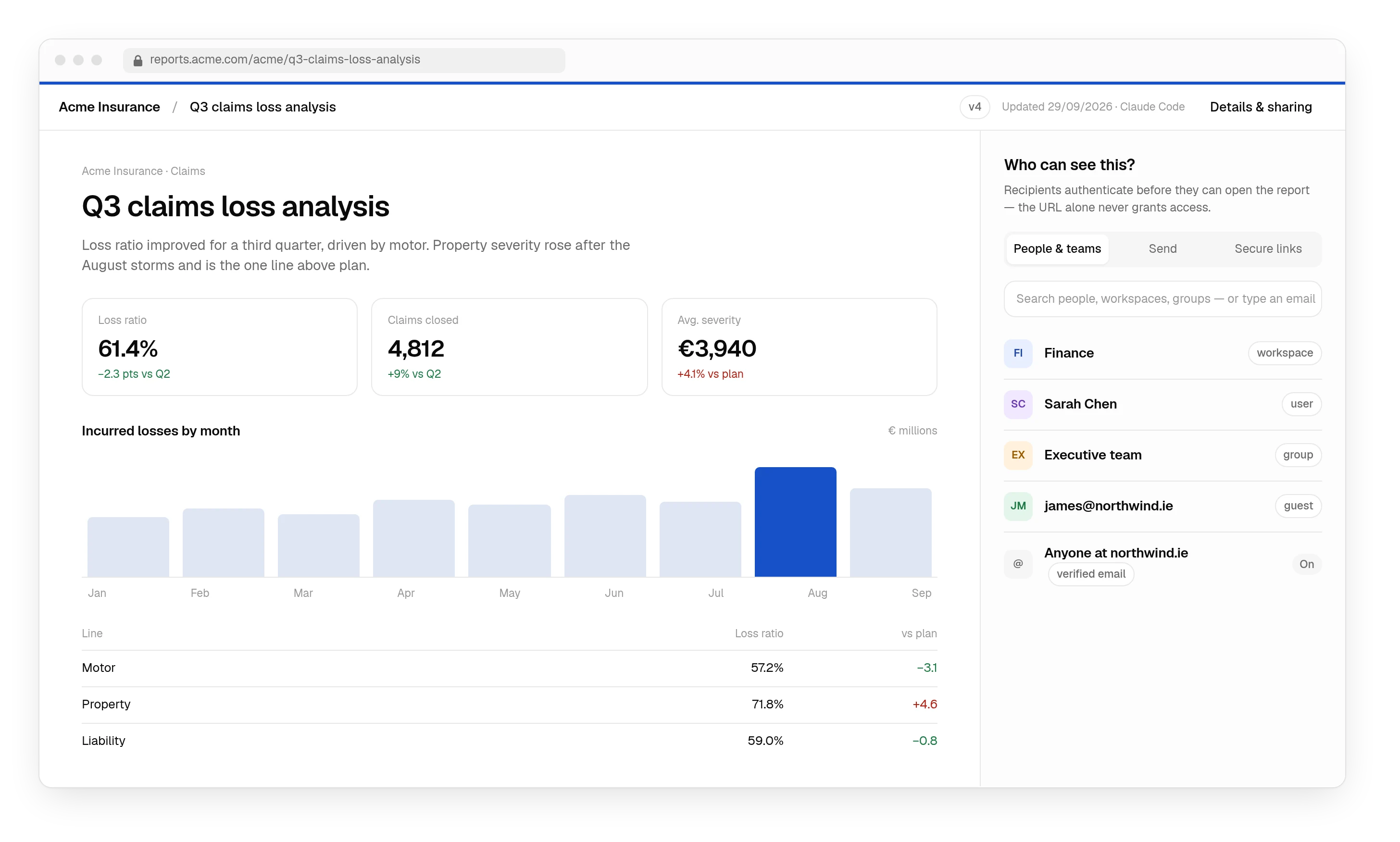
Grant access to a named person, a workspace, a directory group, an email domain or a verified guest who confirms a one-time code. None of them needs an account with us, and none of it requires making the report public.
Whole bundles, not one page
Publish a folder: multiple pages, stylesheets, images and data files, with relative paths that resolve. Libraries referenced from a public CDN are fetched and inlined at publish time so the page keeps working without external access.
Publishing from anything with a token
MCP, a REST call, the CLI or a CI job. An agent gets its own publishing identity scoped to the workspaces and audiences you allow, and cannot publish publicly at all.
Your own domain, and a schedule
Serve reports from a hostname you verify. Put a recurring report on a schedule and your agent is told when it is due, publishes the new version to the same URL, and the same approved audience opens it.
An audit trail you can export
Who published, who opened it, who shared it and every access change, retained to your policy and exportable as CSV.
Questions.
Do I have to choose between them?
No, and most people should not. Use an artifact for the quick look inside your team, and publish to Deliverd when the report has an audience outside your Claude organisation, needs to live on your own domain, or has to keep going out every week.
Can Claude Code publish to Deliverd directly?
Yes. Connect the MCP server with one command and ask Claude to publish. It never writes a token to disk — you approve the connection in a browser.
Is the report still interactive?
Yes. CSS, JavaScript, charts and tabs keep working. The HTML is served from an isolated origin, separate from the Deliverd control plane, and scanned before it goes live.
What happens when I publish again?
The URL stays the same and the previous version is kept. You can compare them, roll back, or pin the report to one version so every reader sees it until you unpin.
Publish it where the right people can open it.
One of Deliverd’s primitives, beside approvals, gates, tasks and evidence. Free to start. No credit card.